Blog

My New Favorite Book

The collicular self has the power to turn to something or turn away from it without our awareness of that ‘decision.’

Learning More About the Brain (some very basic basics in 3 parts)

This is the second of several posts I’m making in attempts to digest this really important read. Here, I’m breaking down some new brain info.

Subcortical Brainstem Structures Involved in Immediate Responses to Traumatic Events

1) Superior Colliculi

WHERE
2) Periaqueductal Gray

WHAT
3) Locus Coeruleus

SHOCK
A multisensory integration center, registering novelty in the visual, auditory and somatosensory fields.
Coordinating immediate orienting behavior.
Involved in the generation of affective (e.g., panic/grief, rage, fear and defensive (e.g., fight, flight, freeze) responding.A noradrenaline system with diffuse projections across the cerebral cortex.
Heavily involved in arousal and attention.

Signaling extreme levels of volatility.

Orienting to WHERE

One of the first things we are being asked to learn in order to deliver DBR therapy is to help our clients locate a central place in their being from which they sense the world and know where they are in it.  Anatomically, this place is represented by a brain structure called the Superior Colliculus.  It sits on top of the periaqueductal gray, about which we will go into deeper detail later.  It looks, maybe, a little like this:

  1. Midbrain and Upper Brainstem Component of the WHERE System, the Superior Colliculus This is an orienting structure which “has sensorimotor capacities for effecting inquisitive, acquisitive, and protective responses in relation to the unknown.” (pg 6)

“The collicular self has the power to turn to something or turn away from it without our awareness of that ‘decision.'”

I’m making mental notes here that the Superior Colliculi  (Pg 16):

  • Serve as an integrative hub for mapping the self in space
  • Receive information from the retina, spinal cord and cerebral cortex
  • Orient to what is unexpected and novel about the world around us

You have a sense of your body’s position – how the limbs, torso, neck, and head are placed – and how you are gently held in your chair by the earth’s gravitational field.  You are in the place where all this information comes together.  This ‘collicular perspective’ is the integrative hub from which your attention radiates outwards to illuminate space with your awareness.  Before identifying what you see or hear, you are first aware of WHERE.

As academics and psychologists, we have long been witness to mixed responses from youngsters and adults alike who are both attracted (compelled to attach) to someone because they represent the very things they need to survive, but at the same time are compelled to escape because they elicit great fear or confusion.  This same disorganized response is the domain of the Superior Colliculi, as it turns out–at the micro level.  It’s where those opposing orientations begin.

Opposing orientations have important implications for how we understand the effects of interpersonal stimuli that are both a source of nourishment and threat.  (Pg 23) 

“Horrific experiences activate simultaneous forces of attraction and aversion beyond our control, resulting in an entanglement of orienting responses.”  (Pg 24)  And this is what DBR is uniquely suited to do.  To slow the process (social interaction) down enough so that these opposing orientations can be witnessed, held, and worked out by the body, with the help of a safe objective witness, once and for all.

The WHAT – The Generation of Affective and Defensive Responding

  1. Midbrain Periaqueductal Gray (the primary structure for the WHAT response system) – our defenses: fight, flight, and freeze, and our affects: fear, rage, and panic/grief arise from this brain structure.  The periaqueductal gray has a role in active and passive defense responses and their associated autonomic nervous system changes. (Pg 6)  

It is sweet to have a real basis for knowing and discussing the fact that deep somatic and visceral pain of interpersonal origin actually exists.  We can know this now because of the machines that are indeed measuring it as we write and read this, and the scientists who are formulating these measures.  We can also know that others are, in fact, investing their academic careers to studying the behavioral relevance of such pain.

It’s reassuring and validating to read descriptors such as “social rejection” in scientific journals.  Even though few of us, outside the field, have given much thought about the moment by moment, day by day, year by year interpersonal events from the perspective of our newborn, or infant self.  Or that in our parents’ or grandparents’ generations infants were thought not to actually have a self, feelings or memories.  An infant’s perspective might not occur in words, but it most certainly endures in the form of somatic memories.

A behavior researchers call “withdrawal” refers to what subjects do, behaviorally, upon experiencing a social loss.  Social loss, they say, activates “PANIC/GRIEF systems, related action tendencies of fight (confrontation), flight (socially evasive behaviour), and freeze (social anxiety).” (pg 44)

Characteristics of the Periaqueductal Gray Columns

SHOCK – A Noradrenaline System with Diffuse Projections Across the Cerebral Cortex

  1. Originating at Pons level in the midbrain, the Locus Coeruleus Heavily involved in arousal and attention, the Locus Coeruleus signals extreme levels of volatility.

Stay tuned for more of my processing of this lovely piece of scholarly work. If you are a counselor or therapist supporting clients with trauma and/or dissociation, or think you might have experienced early relational trauma, I highly recommend that you read it for yourself:

Deep Brain Reorienting: Understanding the Neuroscience of Trauma, Attachment Wounding, and DBR Psychotherapy, by Frank M. Corrigan, Hannah Young and Jessica Christie-Sands

Speaking the Unspeakable

What are you doing here, and why?  It’s important to be tuned into this, probably more now than ever before. I am a counselor specializing in childhood trauma.  My tools, experience and temperament help clients reconnect with and understand emotional messages from their bodies.  Our work together empowers them to honor themselves and achieve their unique paths. 

The client that I like to work with is willing to speak of unspeakable things.  Which is not easy.  But the person I can help is willing.  And that seems to be what I have a knack for.  To help a person feel safe enough to go there.  I help to soften what is calcified and leaking toxins from inside.  I help provide a space where what has been longing to be seen and held feels invited and named.  When the client is willing, I create the setting where the unspeakable can feel safe enough to emerge.  That is what I noticed about therapy I have had in the past–that I just literally could not think of any “logical” problem that I needed help with.  The unspeakable needs to be coaxed into the room.  It is the unspeakable that I invite, so that it can get the care and attention it is longing and yearning for.  So it does not weigh so heavy in the soul.  Here are some of the things that feel welcomed and therefore transformed (and unburdened) in these healing spaces.

THE UNSPEAKABLE

Shameful Things

  • Jealousy
  • Being Hateful
  • Resentment
  • Disappointments
  • Greed
  • Rage
  • Selfishness

Silly Things

  • Overreactions
  • Embarrassments
  • Childish Things

The Pathetic

  • Things I’ve Learned Not to Focus On For Good Reason
  • Things That Could Come True or Get Worse If I Think About Them at All
  • Things That Might Come True If I Dignify Them With Language
  • Things That If Uttered Aloud Would Make Me Unlovable
  • The Whiny, the Annoying, the Shameful
  • Things That Could Send Me Straight to Hell
  • Things I Should Have Been Punished For.  Things I Punish Myself For.
  • Things My Body Does and Doesn’t Do That Are Too Tedious and Too Embarrassing to Ask Anyone to Help Me Sort Through
  • Things I Should Have Been Able to Take Care of Long, Long Ago

I can help you if you are brave enough and willing to change, and maybe just need a place you can go to take–not all your scary baggage at once, but–the part that is ready now.  I delight in meeting the person who knows they can be more of themselves, and just needs some reassurance, encouragement and a gentle witness to what they are going through, and what they have survived.  

You might be aware of the shame and fear you feel about what you have been carrying.  But if you are willing to show up anyway, you can unburden yourself.  Maybe you have been betrayed; maybe you have betrayed others.  But if you are still willing to take the chance, you will find what you seek, because you know the stakes are too great if you don’t.  I want to work with you if you are interested in getting the kind of support you have been seeking all along, but somehow not finding.  If you want to be supported in following a feeling as it shows you some beautiful thing you didn’t know was sacred about you.  In the end, the clients who benefit from what I have to offer give me the astounding gift of seeing how universal our problems really are.  I am truly blessed to know you, and hear you speak of unspeakable things.

Photo Credit: AjabaNature

Deep Brain Reorienting – DBR

Deep Brain Reorienting: Understanding the Neuroscience of Trauma, Attachment Wounding, and DBR Psychotherapy, by Frank M. Corrigan, Hannah Young & Jessica Christie-Sands

How can it be that at the highest echelons of mental health, professionals are trained to avoid talking about trauma because it destabilizes patients? Yet, according to Frank M. Corrigan, this seems to be the status quo in our mainstream medical system.  Like Frank, I believe that so-called developed countries need to do better in acknowledging the impact early relational trauma has on our nervous systems and our lives.  Only in this way can we actually begin to provide the kind of welcome our most vulnerable community members need in order to grow into their best, fullest lives.  And only in this way can we begin to reclaim our own nervous systems so that we can live in harmony with our bodies and the planet, starting now, at whatever stage of health we’re at, which is something that is so vital to all of us during this important moment in human history.  

How can it be anything but obvious that our earliest experiences set the tone for our lives, and that the tender love and consistent-enough attention of our mothers is central to our wellbeing and development?  So much so that in the first hours and days following birth, the availability or absence of a warm and conscious presence imprints on the nervous system and puts in motion ways of being in the body that will shape our relationships and our physical health for a lifetime.  What should not be earth shattering news is that when a human infant does not get these early needs met, the body responds with shock.  If these ruptures are not repaired, it will leave the body in a chronic state of hypervigilance and trauma.

This is what mental health providers the world over are facing today.  How to help clients and patients with chronic anxiety, depression, troubled relationships, and a general sense of disconnection from themselves, others and their own agency in the world. 

Frank M. Corrigan suggests a sort of cultural dissociation from the reality of early relational trauma that lies not-so-subtly alongside an implied institutionalized decision by our medical establishments that trauma-derived disorders are simply too expensive to treat.  Frank M. Corrigan is speaking my language.  Though it’s clearly not USAian English.  In fact, he’s Scottish!  Corrigan is the creator of Deep Brain Reorienting, a body-oriented tool to treat shock, trauma, attachment wounding and deeply stored, unprocessed pain.

Deep Brain Reorienting brings something revolutionary to my toolbox, though I’ve specialized in trauma for almost 20 years.  With DBR, we are slowing things down, looking under the hood, and addressing some important things that happen in the brain well before trauma sets in – even before emotions.  It’s basic physiology, but it’s also sociopolitical.  In this trailblazing book, I’m finding answers to questions I didn’t even know I had.  Frank M. Corrigan speaks to my nervous system in a way I’ve never been spoken to before.

Learning Yet Another Technique

With DBR, “The therapist must be directive in eliciting the underlying sequence and then supportive as the healing process flows from within the client towards a new perspective.” (Pg 9)

Orienting Tension

As a practitioner of Eye Movement Desensitization and Reprocessing (EMDR), I have learned how to watch for the subtle cues that tell me when a client is effectively processing trauma; I know the landmarks that happen when we effectively transform a vivid, sensory-laden memory that feels here and now when recalled, into a narrative story that can be told with thoughtfulness, current-moment presence, and compassion for the self.  But what EMDR is not as good at is effectively addressing pre-verbal trauma.  I don’t know about you, but I didn’t acquire the use of spoken language as a means of communication until I was probably well into my third year.  And as much as it vexes me, talking about the unresolved trauma my nervous system has been managing since birth would not be a worthwhile pursuit for me in a therapy session.  Still, growing up in a family that had little time or energy for emotions, there is still a considerable amount of work to do in that addled nervous system of mine.  Lucky for me, now that I’ve been introduced to Deep Brain Reorienting (DBR), I understand that there is a whole additional set of cues that we can become familiar with when we work with clients, and when we begin to heal our own nervous systems from the ruptures in attachment we experienced when we – as infants, toddlers and small children – were so completely dependent on the adults in our lives.  And when we address these things, our worlds begin to expand.  We are capable of so much more than we ever imagined.  

This new set of cues includes tension in the muscles at the base of the skull, around the eyes, and/or in the forehead.  The sensations here are referred to as orienting tension because they include muscles that become activated when “our attention is drawn to something salient, even if we do not move our eyes or our head.”

This orienting tension provides a connection with the system for the ‘whereness’ of the body, and (during therapy) it enables attention to traumatic material without being dislocated from present reality.  This is where we obtain the grounding anchor, which reduces the risk of being overwhelmed during trauma processing. (Pg 5)  

In the next weeks and months, I hope to process and share more about Frank Corrigan and colleagues findings and thoughts.  Here are a few of the things I want to take in and “digest.”

  1.  The Nervous System Structures involved in the orienting reflex and shock
  2.  Neurological foundations of Disorganized Attachment – And how they’re healed
  3.  Implications of the diffuse pain of an infant for whom there is insufficient meeting of the need for contact
  4.  The sense of personal agency, and how it responds to early attachment disruptions
  5.  Neurochemical Dissociation and the endogenous opioids that deliver analgesia for emotional pain
  6.  Recognizing the physiological symptoms of shock
  7.  Bracing: The degree of holding in the axial structures is indicative of the level of underlying pain that is being continually braced against

Photo Credit: Rosy Ziegler / Bad Homburg / Germany

The Tarot of Tuesday’s Emotions

I was indulged with several readings at a coffee shop on Tuesday morning by a gifted friend in JC who is studying tarot.  The reading I’m going to talk about here is a 5-card Life Purpose spread that is telling me a lot about emotions, which is delightfully aligned with the Constellations topic for Winter 2025.  Here goes:

Card #1:  II Wands (Reversed) – This position in the spread signifies how I’m really doing right now.  The fact that it’s reversed tells me something about surprise, wonder, enchantment, emotion, trouble, and also fear.  What Jessica Dore says about it in her book, Tarot for Change, is that this card has to do with staying stuck in a wrong situation to avoid the disappointment of something not living up to what my fantasies about it were.  It’s about how one walks away from such fantasies, and back into flow; into what really is.  The two wands represent a doorway of sorts.  Each wand, or staff, represents an aspect of this particular moment in time.  One staff rests on a battlement (war, suffering, chagrin), and the other is fixed in a ring (riches, fortune, magnificence).  The picture is worth a thousand words.  The man in the image holds a globe in his hand, and he’s standing in front of a stunning vista that is apparently his domain.  Will he focus on the replica or the real thing?

Card #2: VI Swords (Reversed) – This position in the spread signifies what I am really good at.  The fact that it is reversed speaks of declaration, confession, and publicity (proposal of love).  According to Jessica Dore, this card is about breaking old patterns, which involves being honest about how I may be actually choosing things that bring me suffering and connecting with the fear that lies at the heart of that choice.  This requires that I be willing to do what’s necessary to bring my attention to the emotions that I have for so long avoided (with good reason).  This exact location, Dore says, is where the pattern can be broken.

She compares what happens in this realm as “driving a bus of monsters toward what matters to me.”  The huddled figures on the raft that is crossing the water could represent self doubt, self criticism, feelings of inadequacy.  The card, she says, points at the act of moving through inner obstacles on our way toward what is personally meaningful.  Hell yeah.  I’m good at that.  That’s what I do.  “Fear is not just a thing to be tolerated, but in fact an indelible part of living in alignment with what’s precious.”  “Fear is the cost of admission.”  Accepting fear as part of who I am, my mantra moving forward could be: I am willing to take a new route if it’s a better one.  I am willing to grow.

Card #3: King of Cups – This position in the spread signifies what my purpose is, right now.  (It is not reversed.)  This card showed up in several places during the morning reading extravaganza, and each time it was upright, which tickles me no end.  Cups, it appears, have to do with emotions.  And as I well know, emotions appear to defy logic.  Dore says that the cups suit is about delineators.  “To understand water is to give oneself over to its currents, instead of trying to put it into containers with labels.”  This card signifies, she says, that we’ve talked and reasoned and prepared enough, and now it’s necessary to drop into the water itself.  And according to this spread, this is my purpose, right now.  Go figure.

“People in cultures all over the world in geographic isolation from one another have generated and told stories with motifs and characters that echo or resemble one another since time out of mind.  Queens belong to the realm of imagination while kings belong to the domain of will.  But for King of Cups – King of Imagination – will looks different.”  Here we see a more receptive application of will, or active acquiescence.  So my mantra might be: I am prepared and ready to do what is required in order to accept and stay afloat as the waters rise.  Luckily, the card tells me that I have the competence to find resolution where others have been unable to.

“Emotions are often passed down through generations until they reach someone who has the right set of resources and abilities to resolve them.  Clearing a space for them to emerge, unfold, and find full expression.”

“The King of Cups protects the rights of emotions to have and experience the full cycle of life: to be born, to have a safe space to fully express and to die, eventually.”  Emotions have a beginning, a middle, and an end (unless, of course, we clamp down on them to keep them from moving through, or otherwise repress them).

“Knowing this helps us to become willing to actually feel what we feel.  Humans can endure more pain when they know it’s time limited.

“This is the way an emotion makes its way out of an individual, out of a family, and ultimately out of a bloodline.  And so if you are feeling something big and deep, consider your kingship.”

My takeaway from this card: I have the tools and temperament to usher the thing through once and for all, and this is actually my purpose now.

Card #4: II Swords (Reversed) – This position in the spread signifies whatever might be getting in my way.  The fact that it is reversed speaks of Imposture, falsehood, duplicity, disloyalty.  Swords are the domain of thought.  I have long been aware that I rely heavily on my mind.  This card tells me that I can use my intellect to my advantage and that I have skill at this.  But it also signifies that it is my mind that can get most in my way.  Fears of imposture, duplicity, disloyalty.  Working with this card demands that I continually examine which thoughts I give weight to, and which ones I choose to speak out loud.  It asks me to be exquisitely aware and present when I speak about who I am and what I desire right now.  This has been a particularly important aspect of my life right now, as my identity shifts and morphs as I step more fully into these roles in my life that acknowledge and honor even more of me.  Dore also points out that this card is about honing knife skills, which involve cultivating a bit of cunning.

In staying in contact with what one knows to be true, Dore says, sometimes you need to lift your head up, roll your shoulders back and act like you know.  Here’s an interesting line from this chapter: “I’m too scared to admit what I know, or to do what knowing requires of me.”  And keeping the blindfold on (not making a decision) can be protective when it’s not the right time to make a choice. 

“We form an alliance with ourselves by choosing narratives that are supportive and empowering rather than disparaging.  If you wouldn’t describe a friend who was hesitating to act on what they know to be true as ‘confused’ or ‘lost’ maybe don’t talk about yourself that way either.”  I really appreciate this.

Card #5: Ace of Cups (Reversed) – This position in the spread signifies how I can love myself so I have the energy to fulfill my purpose.  The fact that it is reversed speaks of mutation, instability, revolution; House of the false heart.  This card was exactly what I needed during this time, as my focus is on emotions; on seeing and dealing with them newly.  I have not known my emotions well enough to name them, much less to be true to them, but I am willing to grow from here.  It is the work of a lifetime, making good enough friends of our bodies so that we can access what is alive in us in the moment.

Ace of Cups represents “House of the true heart, joy, content, abode, nourishment, abundance, fertility; Holy Table, felicity hereof.”  In this chapter, Dore talks about how psyche is something we exist within – it’s bigger than our physical body.  She points out what mystics have known for centuries, that internal and external life are linked.  As this card shows up in a spread, it might be asking, What is my environment expressing through me?

This card is also linked to the High Priestess, and the practice of contemplation (as the creative process of coming into dialogue with other forces such as emotions).  Breaking down the roots of the word contemplation, she points out that “The prefix con-, meaning ‘with,’ tells us that it’s a collaborative process, and templum, the Latin word for temple, connotes a sacred space where a deity was believed to reside.”  And so to contemplate is to engage in spiritual dialogue, which, like all dialogues, is going to involve both speaking and listening.

This card encourages me to slow down enough to listen.  “What you’re listening for might be an invisible force, like that of helping spirits, energetic currents, or a Higher Power.  Or you could be listening for something concrete, like a river over rocks, birdsong, a groundhog’s rustle through high grass.  This way of being in a receptive relationship with what surrounds us seems difficult for modern people of the West to understand.  We think in terms of the individual, the hero, the character who performs tasks and overcomes obstacles.

“But the cups, in addition to being emotional, are also symbolic of a certain receptivity, as a cup receives water.  Receptivity implies relationship and asks us: What would a more relational way of engaging with our surroundings look like?  What would happen if we reoriented the imagination toward a way that sees the self both as dreamer and that which is dreamt?

“Could we make room for the possibility that what we feel and experience in the flesh house of the body is not always rooted in a private individual experience, but comes from an ecosystem to which we belong?  What if, for example, rather than seeing ourselves as taking a walk through the woods, we see ourselves as being a wave of energy rippling through the consciousness of a family of redwoods?  How would this change the way we move through the environments we dwell in?  How would it change the way we relate to our experiences?

“Emotions are how we understand our raw experiences, not in an evaluative or judgmental way as with intellectual understanding but rather as an intuitive, felt, cellular-type knowing.  The trick – and what’s taught in many behavioral therapies – is learning to suspend action for long enough that this kind of knowing can move through us.

“In her Dear Sugar column, Cheryl Strayed once advised a reader, ‘Don’t own other people’s crap.’  And I’ve thought about that a lot over the years.  To understand the cups suit, we have to get clear on what aspects of our experience even fall into the realm of ownership.  For example, my behavior is something I can ‘own’ or be accountable for, while other people’s behavior is not something that I can or should.  But with emotions, it’s not always clear who ‘owns’ them.  I’ve woken up heavy with the boulder of my grandmother’s grief on my chest, breathed deeply while sweating from the fire of my mother’s rage, and I could say, ‘That’s theirs, not mine,’ if I wanted to, but what good would that do?  Emotions are living energetic currents with life cycles of their own.  They tend to survive down the vertical and horizontal lines of human relationships – through generations, through communities – until they arrive to the place where they can be fully experienced and expressed.  That can take a while.”

I’d better stop before I owe Jessica too much for using her material, but I think you get my point.  My reading was a blessing, as is Jessica Dore’s Tarot for Change: Using the Cards for Self-Care, Acceptance & Growth.  Maybe I’ll put you in touch with my tarot reader friend, too, if you want.  She’s amazing.

I’m on Retreat

and I’ve told many people that I’m taking time alone.  I explored a niggling worry back in the deep recesses of my mind about whether I was making best use of this time; taking my retreat seriously enough.  So far, the answer is a deep and resounding YES.  It’s felt divinely guided.  It doesn’t appear that anyone (ethereal or visceral) wants to punish or even scold me for sidestepping my isolation for an evening with friends and family the first day or driving to St. Louis to be with a friend getting medical results on the second.  I’m thanking my lucky angels for all of it.  It’s all as it should be.  The sunshine warmed me as I ate my Ethiopian leftovers (yesterday).  Today I put the finishing touches on the wonky tarot reading we didn’t finish on Monday. This morning I’ve typed up the notes I wanted to share from Sarah Peyton’s hardback book.  Feel free to check that out here.  It’s just so juicy, so relevant and so comforting.  I finished reading Your Resonant Self Workbook, in bed yesterday morning.  I hiked to the creek at the bottom of the hill twice yesterday, the second time with paper and matches so I could build a fire, sit back and read from another great book.

In a nutshell, here’s the tarot reading.  I drew 3 cards from a traditional tarot deck and am referring to Jessica Dore’s book Tarot for Change, with some of my personal story interwoven.

4 of Cups – Throughout my young life, I had been resistant to taking the good stuff that was being offered to me.  Somehow I couldn’t see it.  I was too hurt and sad and angry.  

9 of Cups Reversed – wish fulfillment, contentment, victory, success.  Reversed it speaks of Truth, Loyalty, Liberty. To accept what we want requires us to also accept the pain of not having it.  This card is asking me to articulate my desires from THAT place.  This retreat is the time to turn inward and care for feelings I haven’t had the courage to look at before.  What do I want to acknowledge and validate so that I can heal and grow beyond it?

As a 22 year old I just wanted what I was taught to want.  So as a married adult woman, living with a husband and a child for 4 and 2 years, respectively, I was entering a place where I had to decide who I really was, and what I wanted from my life.  As an 18 year old, I hadn’t been able to imagine anything else but being a mother and a homemaker.  But that wasn’t working out so well.  As my then husband complained, I was just so predictable.  My higher self was urging me to try something else. And so I did.  Boy have I learned a lot about desire since then.  

Words of compassion from Jessica Dore: “Not knowing what you want is often rooted in things that weren’t your choice and aren’t your fault.”

It’s okay if I’m still trying to figure out who I am and what I want.  It’s okay if I’m still learning to make a good wish.

4 of Pentacles – Crowned figure, Pentacle over the crown.  Clasping another pentacle over the heart.  Pentacles under both feet.  Holding very securely that which I have. (knowledge, concepts, ideas).  Pentacles in general signify physical behavior.

Jessica Dore looks at this card through a different lens: “Transcending and accepting limitations or blocks through the physical body.  Moving stuck energy through the body via breath and gaze with gentle curiosity, not force.  Reframing and perspective shifting = storytelling.  When we relate differently to something, we tend to behave differently around it.  Stories don’t mirror life, they shape it.” – Mary Van Hook, a social worker

The simple fact of identifying a block means movement is happening.  Hitting a wall is not a bad thing.  It helps you know that you need to find a door or a window by changing course slightly or drastically.  Or dig a tunnel.

Calling something a block or a limit or a challenge “is a protest in itself, a statement or declaration that you’re not okay with being contained in this particular way and you most certainly do not plan to shape a life around some limitation that really doesn’t need to be there.”

Learning to live in harmony with blocks.  My body has areas of stuckness and limitation.  Which attitudes and narratives are most effective for clearing blocks?  And for learning to live better with them? The pentacles at the crown block awareness. The pentacles at the heart block connection and understanding. The pentacles at the soles of the feet block action.

“With any kind of block, the first task is to be present enough to notice that it’s there – whether it be physical, behavioral, energetic, emotional, or psychological – rather than either avoiding it altogether or trying to muscle through it.”

It’s not dangerous to investigate blocks.  But when I do it, I need to do it with gentleness, giving myself full permission to back off anytime it gets to feel like too much.

Noticing the block is something to celebrate.  That’s when I know I’m ready to do the work.

Poke around.  Find the malleable parts.  The parts that have some give.  Where transformation can happen, little by little.

Super excited to see what the rest of my retreat will bring.  I’m here until Friday!

Tarot Reading for Today

This spread perfectly describes my takeaway from a recent Constellations Circle. Absolutely love Jessica Dore’s Tarot for Change

Six of Cups  The intellect sifts out what is true; the will reaches out for what is good.  But there is a third dimension to reality: Beauty.  Our whole being resonates with what is beautiful.  When we experience beauty, we start to speak about emotions, and the more we are touched on an emotional level, the more we seek to celebrate the experience, and it’s there that we begin to create ritual.  Benedictine Monk David Steindl-Rast writes that all rituals have to do with, and celebrate, belonging.

The tenderness of the image on the Six of Cups cards tells a secret.  

What if, all I’m trying to do here is to create rituals that have the potential to mark, preserve, and facilitate a return to emotional experiences that are sacred to us?

To feel safe is sacred.  

To be soothed is sacred.

I am a lover of beauty and belonging.  I am a lover of deep emotional resonance.  I am just trying to recall some sacred feeling.  

I am exploring new ways to recall those feelings – and new rituals for feeling safe and soothed.

Page of Wands: Childlike Enthusiasm, Innocence, Wonder, Youth.  Knowing absolutely what I like and don’t like.  According to James Hillman (along with Bert Hellinger): We each come into the world with a calling.

There is something (apart from nature/nurture) unique about each of us – a part of our being that is connected to our “daemon,” which was similar to the Roman concept of genius: Something that you are, that you have, that is not the same as the personality you think you are.

Mythologist Martin Shaw: as adults, too many of us have become “heavily defended against experiences of our own beauty.”

What do I love? 

What captivates my attention?

What grips me?

What lights me up?  What claims me?

Invitation to reconnect with something raw and original within us, something many of us relinquish as we cross the threshold into adulthood.

My specific calling is never far from reach.

Wands show me how to protect the spark and keep it safe so that it can warm me, and also warm whole villages.

Nine of Cups 

Values Clarification.  If I’m going to do the hard work of change, what will make it worth it?  A life compass.  Am I moving toward or away from what is precious?

Knowing what you want is deceptively challenging.  

Exploring what we desire can be hard because:

  1. Often the physical reality of our lives doesn’t line up with what we desire.
    • To accept what we want requires us also to accept the pain of not having it.
  2. Identifying what’s personally meaningful and articulating desires from that place is often in and of itself a whole healing process.
  3. Making a wish sounds like fun until you realize you have no idea what you want.  Until you realize you’re not even sure what it feels like to truly want something and are not convinced you’d know it if you felt it.  This experience of finding a void where a wish ought to be can be profoundly distressing.
  4. Not knowing what you want can bring up shame.  “I’m 60 years old.  I should know who I am by now.”

Making a wish might be hard because:

  1. Your feelings were constantly invalidated, so you don’t trust your own sense of what you like and long for.
  2. You’ve experienced a lot of frustration trying to get your needs met in life, which makes it difficult to want to try.  Feeling hopeless about or quickly shutting down anything you have an inkling of really wanting is how you’ve learned to feel safe.
  3. The people you relied on in childhood were unpredictable or erratic, so you developed the skill of scanning and tending to other people’s needs at the expense of your own needs as being necessarily dictated by the needs of others, so it’s hard to untangle them.
  4. You developed a protective strategy commonly known as perfectionism, which means you organize your life around avoiding contact with any potential indications of being inadequate, defective, or unlovable.  Wishing for or trying new things is a direct threat to that defense.
  5. When you were growing up, no one around you had any coping skills, so you didn’t get any, either, and instead you carry an intense fear of the feelings that come with wanting something and not getting it. Fused with a belief that those feelings are unmanageable, the stakes of having a true wish are simply too high.
  6. A heart’s desire sprouts from a sense of self that’s sturdy enough to have preferences independent of external factors.

There are so many factors that go into the maturation of a budding sense of self, and probably infinite ways to botch it, so even though adolescence is technically the time when we are “supposed” to be doing the work of figuring out who we are and what we like, there are enormous swaths of us doing it in all decades of life.  And we’re often doing it not just once but over and over again as the conditions of our lives change, and with them, our wants and needs.

Sometimes, learning to make a good wish is the work.

Credit goes to Jessica Dore, author of Tarot for Change: Using the Cards for Self-care, Acceptance and Growth

What we Really Want – Redux

A new look at what can be accomplished in groups.

In my travels I’ve met people with varying opinions about bamboo.  Some love it.  It grows fast.  It’s tough and strong, durable; doesn’t break down for a long, long time.  For this reason, it is a good choice as a renewable resource.  A woman I met in Mexico told me she was dedicated to removing bamboo that had been planted and become a nuisance.  She teaches people what can be done with bamboo, and she finds new homes for the plants when she can.  So inspiring, the things people find as their calling in life.

I was thinking about this woman when I was working in a new garden patch in my back yard.  Last fall, I decided to reclaim a patch of earth from a particularly stubborn, tenacious grass that grows back there, which has been serving to cover the ground quite well for decades, requiring nothing but sun and rain and an occasional trim.  But I decided to put in a garden, with watermelon, basil, parsley, mint, greens and tomatoes.   And now I am face to face with this plant – grass, bamboo’s second cousin – that has root systems deep and well established, intertwined and strong and formidable.  It meets the blade of my shovel like iron.  It snickers at my attempts to remove it.  So I get down in there with my hands.  I can find the roots when I get under them, when the soil is damp, and when I’m not in a hurry.  Exerting myself in this way, connecting with dirt and plants really does something for my soul.

In the office, I’ve been fielding more requests for support groups and other types of groupwork.  That is where a lot of my creative energy has been going as of late.  The pattern that is showing up in my one-on-one work has been the particularly tough, entrenched impact of intergenerational trauma that is blocking real progress and growth in the lives of my clients.  It shows up as stubborn and tenacious and sometimes appears impermeable to change.

The feeling is of being really mired in something that keeps sucking one in.  It’s requiring me to take a different look at the way I can offer myself in service to them.  Just so you know, it’s always mutually beneficial because my clients always mirror me and help me move through the processes I desire to work through as they do their work, and they always inspire me, whether they realize it or not. 

I’m noticing that this new shift in the work I’m called to do demands a new level of humility.  It demands that I continuously search out new resources.  I am pushed to continually search for the right tools, and to make care for myself a sacred priority. 

The really good thing about this is that the kind of trauma my clients are bringing to me these days responds to Systemic and Family Constellations Therapy.  

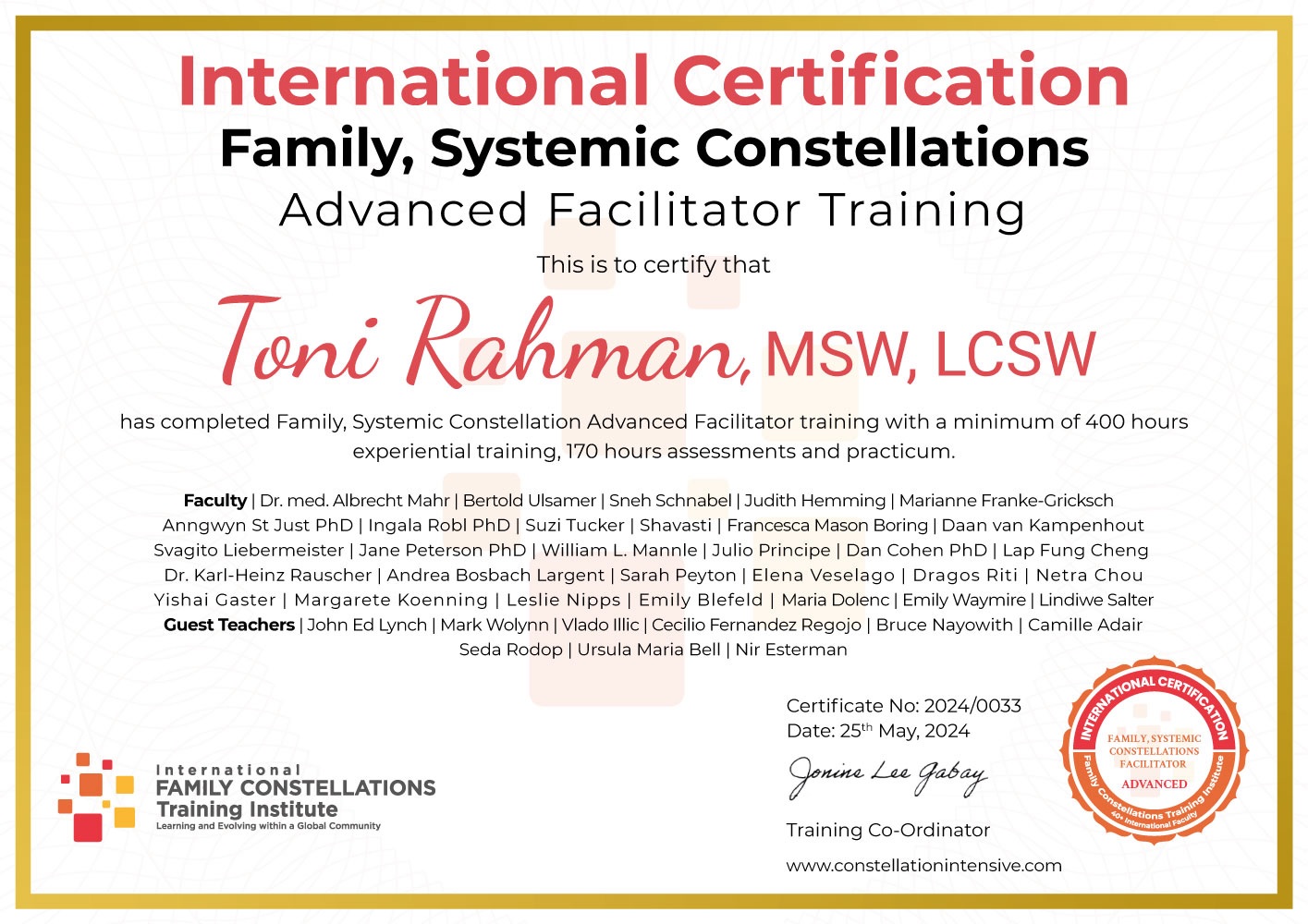
And that is what I want to tell you about now.  Here is a brief description, in case I haven’t already shared this with you.  Over the next weeks, I plan to share on some various themes that I’ve come across in my studies as I’ve been working toward certification.  I’m proud to say that yesterday I completed and submitted my application for Advanced Certification as a Systemic and Family Constellations Facilitator.  I also bought and planted those herbs and greens in my little garden patch, and now it’s raining.  I look forward to seeing what comes of this new vision – of working with others in groups to make real shifts in our experience, to removing obstacles to our being truly generative, vibrant, and expressive of who we came here to be.  I hope they have a short acronym for Systemic and Family Constellations Therapist Facilitator, Advanced! 

Here’s the certificate!

My most recent vision is this:

To more powerfully perform from a place of embodiment so that I can stimulate and support the change that is desired; to collaborate with others to bring about not just a quick fix but transformation in the felt sense of people that I work with – that we finally know what it feels like to be held, to be supported in community, and believe that there is Something Bigger that we can lean into.  And that joy and peace are our natural state, and that it is available to us in these bodies on this earth.  To know what it feels like to be supported to move toward what we want, what we desire, what we need to make this life truly matter.  And to celebrate all the movement (large and small) toward this goal.

Ramblings – Interpersonal Neurobiology & Affirmations

Interpersonal Neurobiology.  This is a pairing of words that always gets my attention.  Some days it makes me feel inadequate because I haven’t chosen this as a field of study, per se.  Some days I feel sad because I want to have the title Interpersonal Neurobiologist, and I don’t.  But today it just makes me sit in wonder, pure awe of the universe we live in, and the things we get to do here.  

I guess I could say that I know a fair amount about interpersonal dynamics.  I could say, also, that I have made a decent attempt to inform myself about the nervous system and how the nervous systems of individuals respond to other nervous systems, and how we come into our lives here on earth with nervous systems that aren’t fully developed, and we need the nervous systems of other people, particularly our mothers, in order to develop and properly grow and mature.  I can unarguably claim over half a century of experience trying to figure out how to regulate my own nervous system, and have actually had some success in the past decade or so.  And now, from a place where I have some agency and confidence around my ability to calm my own nervous system, I am discovering that I am excited about getting even better at it.  And excited, also, that this can only be done with the help of and in the company of other people.  I can honestly say that this–at this particular moment–terrifies me almost as much as it thrills me.  I know this because of a nightmare that woke me up this morning.  I come back to that later. 

But whether it is a community potluck, a group of people sitting around a bonfire, an online class, group therapy, a 12-Step Group, or Thanksgiving Dinner at Grandma’s, people can come together and actually be better off from having done so.  Am I the only one feeling the profound potential here?  Because if I’m honest, tapping into and using this potential has not worked well for me in too many contexts in the past, and since that has only relatively recently changed for me, I want to compare notes with those of you who are still reaching and yearning and working for rich and deep and satisfying and inspiring and gorgeous and transformative interactions with other humans as the new normal.  

As I survey what I see as our dominant society and culture, as humans in the 21st Century, we have created, on the grandest scale, groups, systems, institutions and organizations that at best are failing to produce what we most need in the world today and at worst represent all of the things we loathe and wish with all our hearts to avoid. Yes, there are good things happening, but I am not willing to dismiss this overarching state of affairs right now.  Families too often fail to protect and nurture their children, churches intentionally terrify and bewilder us and extract our resources, governing bodies fail to come together to represent or serve our best interests.  And I don’t even begin to have words to talk about our economy.  Resources, time, money and life force energy is being wasted in all the ways.  We try, like swashbucklers, to make these groups and organizations work for us, to do our part; to do the right thing.  But in the end, maybe the only way to maintain our sanity is to accept that we can’t and never will be able to make these groups work for us.  And to accept that it’s actually okay, because we can get what we want and need (and have a whole lot of fun while we’re at it) anyway.  (I do realize that there are people out there whose truth it is to work in institutions, and my hat’s off to you.  I don’t diminish the value of what you are doing.  It’s just clearly not my gig.)

What if it’s true that there is absolutely nothing stopping us from convening and collaborating our intentions and energies in a different way? What if we can count on ourselves and our own senses to know what we desire, so that we can join forces and explore and create and play?  And what if organizing with safe others for creative play is actually the solution to all our problems?  That is the realm in which my interests lie at the moment.

As I push myself to do things outside of the familiar; outside of my personal comfort zone, I am benefiting in so many ways.  In preparation for our next Family Constellations Circle, I can identify, name and use my fears, my emotions, my worries, to build reassurances and encouragements and positive statements to use for myself to help me calm my nervous system (because Toni, who do you think you are to be doing something so bold and outside the box? is notably not calming my nervous system).  

Spoiler Alert: this post ends with the list of affirmations I plan to use for the next couple weeks.  Feel free to use those affirmations that have meaning for you, and use any others as seed ideas to build your own affirmations if that helps you to reassure your vulnerable inner children.

I’m pretty sure my angels and guides woke me up this morning with a dream and a realization that I need to double down on identifying and removing hidden obstacles to speaking from my heart in real time.  Because this is the reason being in groups has not worked for me in the past.

My work now is to use my dream material to help me notice and name, one by one, the things that may keep me from speaking freely from my heart in real time.  See if any of these resonate for you too.

  1. Shame about being so caught up in my own anxiety and stress that I can’t receive information from my senses about what’s happening in the moment. Disappointment in myself for not performing up to my own standards or as well as someone else who I’m sure could do it better.  Shame for not being in control of my own body/nervous system.
  2. Fear of being blindsided by a trigger reflex, which shuts down the ability to enjoy connecting with others. Fear of missing the juiciest and sweetest parts because I’m so fixated on something that “should” be and isn’t, or getting it perfect.
  3. Fear of having to pretend to be completely present, calm and relaxed, while actually feeling a bit stunned and not sure I can connect to the words I need to express what I want to express and to accomplish my goals.  Shame because I’m not feeling the calm and relaxed and grounded state I’m asking my group to feel.  Fear that I won’t have what I need when I need it.  Fear that I am inadequate, a fraud.  Fear that what I have to offer (me being me, with my ideas, my contribution, my emotions, my processes and needs) is not of value.
  4. Fear of inadequately or incompletely expressing the breadth and depth of myself, my knowledge and lived experience.  Being misunderstood.  Fear of selling myself short, fear of disappointing people, of not delivering what others want and need.  Fear that I can’t trust myself and my instincts.
  5. Fear of not having the integration I need to express myself in an engaging way when I want to.  Fear of not being healed enough or skilled enough or capable enough or worthy of attention and trust.
  6. (and get this) Fear of actually getting what I’m asking for; of truly succeeding.  Fear that if I succeed, I won’t be able to handle the big feelings and issues and problems that come with that.
  7. Chronic, unconscious muscular tension.  Unconsciously clenching muscles.  In the body in general, including but not limited to the physiological avenue of expression.  Chronic, unconscious tension in the body restricts the free flow of information from the body to the brain and vice versa.  I suspect that I have yet-to-be-identified muscular tension that keeps me from expressing emotions as they come up and advocating for myself, especially in circumstances where I feel I might be out of line somehow, or going against dominant paradigms (which is just asking for bad things to happen, right?)  Women can’t be openly powerful or successful (without paying for it).  It’s not safe to be powerful.  It’s not safe to openly be a channel for the divine.  

And at the bottom of all of that I notice a subtle but very primal fear of being cast out, being rejected, being dismissed, being exiled, or otherwise paying the price.

Affirmations

  • I’ve actually been experimenting with bringing more consciousness to my desires and actively manifesting more of what I desire in my life.  
  • The results I’m getting are practically immediate, mostly delightful, new and surprising, and I am learning about myself as I go along.  
  • I get to make adjustments when unexpected things crop up and I become aware of needs I didn’t know about before.  
  • I am capable of learning from my experiences.  
  • I’m actually not too bad at this.
  • It is my responsibility to value and honor myself by building in spaciousness and care and attunement around any group offering I decide to make (risks I take in new areas of my life, around tender new skills I am just developing).  
  • I accept that responsibility and make self care a priority, fully realizing that I will perform better and feel better about my performance if I am better prepared, physically, spiritually, emotionally, psychologically.  
  • I have all the support and guidance I need to adequately prepare for these events.  
  • The fact that I can imagine how it feels when I can relax and draw on my experience and knowledge to hold the space well (help my group members feel comfortable and prepared to participate in a group that goes the way I want it to go, and benefits all who attend) tells me that I am capable.  
  • I can accept myself exactly as I am as I strengthen my skills.  
  • I am worthy of consideration, kindness and patience as I learn and grow.  
  • I do not have to be perfect.
  • When I get clear on what I want and need and articulate it, my needs are met as if by magic.  
  • My feelings help me know what I want and need.   
  • I know something about emotions and nervous systems, and I can trust myself to come up with the words I need to adequately express myself.
  • This is not a competition.
  • I don’t need to compare myself with anyone else.
  • I can just be me.
  • I am good enough.
  • I’m not asking too much of myself.  
  • I do this with every client, reliably.  
  • The only thing is I am increasing the number of people I’m doing it with at one time.
  • I’m in this for the long haul.  
  • I am committed to learning how to care for myself well.
  • I am gaining more and more confidence in my ability to stay emotionally regulated and present in any group space, especially those that I call and facilitate.  

My responsibility is to hold the container knowing that I can respond appropriately, and guide the process.

  • I trust that I am adequately supported to do this, and that it is mine to do.
  • I give myself grace, knowing that I am human, and I will probably not do it perfectly, but that it will be okay.
  • Participants will be able to give me feedback that I can digest and integrate as appropriate.

What makes this risk worthwhile to me, is that in larger groups, we can accomplish extravagant healings in the context of the constellations, while learning even more about family systems and how they work, and how we’re more connected and alike than we ever knew.  And we can actually participate in and support the healing of the others in the group in ways we never imagined were possible–all while bringing that same healing to ourselves.  All of us benefit, and the effects ripple outward into our communities and the world.

Gleanings from the Dream

  • I’m pushing up against my comfort edge, learning something new.  
  • In the role of teacher/facilitator, my responsibility is to the class, ensuring safety, and making sure people have my calm and compassionate presence.  
  • This is not particularly new.  What is new is being recognized for it, asking for and receiving support for it, and getting paid for it.  
  • Neuropathways in my brain are being built, but many of the most essential ones are not even approaching finished.  
  • This could take some time.  
  • I need to pay attention to my habit of scrambling to fulfill my responsibilities to others.  I can relax and trust that all is as it should be.  I am not alone.  
  • I’m noticing that I have been efforting quite a bit, failing to recognize and honor the stage of development that I’m at.  There is risk in forcing things to happen before their time.  
  • Ultimately I have to surrender and accept that the way I need to go (the long and slow way around), while it seems cumbersome and inefficient, it is way more effective and efficient in the long run.  From where I currently stand, it is apparently the only way, and all I can do is accept that and work with it. 
  • Pay attention to the process.  There are profoundly beautiful and unexpected scenes along the way, not just at the end.
  • I am definitely not on my own.
  • I can always count on my wise, creative self who is always working behind the scenes to help me problem solve, and connect with other very capable and state-of-the-art supports so I can regroup and return to my creative goals and responsibilities.

Playing With Subtle Energies: Explaining the Unexplainable

Hello Friends,

Many years ago I was introduced to this mysterious, powerful, and beautiful therapeutic modality called Family Constellations. Immediately fascinated and enchanted, I sought out a group or a therapist here in the Midwest, and had my own constellation done. I had to drive all the way to Sedalia, MO and the group that assembled there was quite small, yet still powerful. That therapist has since passed on, and I’ve moved forward in my life as well. In Mexico, I learned that Family Constellations work is extremely popular, and most of the therapists I met had been trained in it, use it in their therapies, and many offer regular groups. In 2013 I attended a 5-day “congress” about Family Constellations in Acapulco, Mexico, attended by a huge number of people, with speakers from all over the world, and my adventures south of the border kicked off that way – in the realm of the magical, Explicando lo Inexplicable (Explaining the Unexplainable). I began attending these groups in Guadalajara as often as I could. Often they brought me to tears, even in Spanish, because they worked with something much older and much more powerful than words. And I could feel things shifting and reaching greater integration in my body, a deeper, very resonant feeling that my problems are not so unique, and that so many of them have been passed down, from past generations. In the world of Family Constellations, things can be put right though. Repairs can be made, and it is a truly beautiful and awe-inspiring thing.

I’m telling you about this now because I have a desire to play with the subtle energies of this therapeutic modality, and as I am still learning how groups in general work, I won’t be charging what most constellators charge. And I want it to be available, even for people who have limited resources. Contact me if you want more information, if you think you and a few people in your community might like to set something up. We need anywhere from 8 to 18 people, and a place that is quiet and large enough for us to move around in.

I can see how my exposure to Family Constellations as well as my training and background in CranioSacral Therapy both shape and affect my EMDR practice, and I now use a kind of hybrid of all three with my clients. We have started a constellation group in Columbia and our first four circles have been extremely powerful. Having the ability to take my work into a group context excites me no end. I’ve included a couple links so you can check it out below. Let me know what you think.

https://www.ulsamer.com/family-constellation/family-constellations-according-to-bert-hellinger/

Rupert Sheldrake talks about Family Constellations and the morphogenic field. You may want to Google that topic and follow your own curiosity.

The swirling blue on white figures in the image I include with this post make me think of the “as above, so below” phenomenon that we see in nature, and the correspondence between different planes of existence. Here, I almost see both the neurons that make up any living organism (or a brain!) and the humans that make up any living community. The design was part of the 2013 Constellations Congress I attended in Acapulco.

Learn about the Zulu origins of Family Constellations here.